For my school newspaper, I wrote varying types of articles. Below, I have included examples of editorials, people stories, news articles, reviews, and feature stories. I also wrote several articles for the school's last three yearbooks.
Column
My column is my favorite part about writing for the newspaper. I love choosing an issue and stating my opinion. I decided to name my column space "Reading Between the Tweets." I found a tweet relating with each column topic and included a picture of the tweet. I liked the idea of combining the media, which is so relevant today, and my columns. I wanted to make students more interested, and incorporating social media helped. Oftentimes, I used tweets from students at the school, with their permission.
Published in the Zephyr Newspaper
A few weeks ago, on Mar. 6, social media exploded with memories, photos, and quotes relating to Nancy Reagan. The passing of the former first lady raised an open-ended question in my mind. What is the job of the first spouse? How has it changed?
Though the job has no specific requirements or duties, the role of the first lady has evolved significantly throughout the years.
Long ago, first ladies stayed out of the public eye and kept to themselves. Throughout history, they became a symbol to the public and the official White House hostess. They threw grand parties and balls, organized events, and attended ceremonies and functions of state. Some, like Jackie Kennedy and now Michelle Obama, have served as fashion icons for the American public.
Recently, though, first ladies have taken advantage of their platform and used it to fight for causes they believe in. Lady Bird Johnson played an active role in her husband’s war on poverty and involved herself especially in the Head Start program for young children. Nancy Reagan raised drug awareness. Hillary Clinton fought for healthcare. Michelle Obama replaced our flour tortillas with all-wheat everything.
I’m glad the first ladies have started to promote worthy causes and break boundaries, but many Americans still view them as the traditional, White-House-decorating ladies that movies always seem to portray.
So the big question lately remains: What if Hillary gets elected? Bill will serve as the first first gentleman of the United States. Will Bill choose the flowers for the Governor’s Ball and organize the White House Easter Egg Roll? No, probably not. And it seems to be a widespread agreement that not just Hillary, but Bill and Hillary will be running the country next January if she gets elected. That seems to upset and worry a lot of people. They are skeptical of a couple co-running the nation.
I happen to wonder what Michelle Obama has been doing these last few years. Do people not wonder if Barack often asks her opinion? Are presidents not allowed to ask for their spouses’ advice and counsel? I highly doubt Michelle’s Harvard law degree is utilized only to choose between chrysanthemums and orchids. People often forget how qualified the first ladies are for the position themselves. Hillary also obtained a Yale law degree, while Jackie attended college at George Washington University and Georgetown University in D.C. These ladies aren’t just flower experts; they are highly educated individuals, and I’m sure they’ve had an effect on just a few of the presidents’ decisions.
So for the American people to cause such an uproar about the first man in the position seems silly. Sure, if Hillary is elected, she and Bill will make history, but will Bill affect his spouse’s decisions as president any more than Jackie, Michelle, Nancy and Lady Bird did?
It’s frustrating to think that the potential first man will be the cause for re-evaluating the duties of the first spouse; those women have been more than White House decorators for decades.

Published in the Zephyr Newspaper (Dec. 2015)
The holidays, a laid-back time of joy and giving, are quickly approaching, but announcements of shootings and terrorist attacks still flood the news, dampening the usual festive, worry-free season.
Since the Paris attacks, it appears that citizens feel certain of an impending attack on American soil, and a recent poll conducted by Washington Post and ABC News reveals that while 45 percent of Americans feel confident in the government’s ability to prevent an attack on American soil, 55 percent say they have little or no confidence. The fear is palpable.
In response to this worry, many people are allowing terror to dictate their lives. I heard several friends make comments about being afraid to go to Black Friday shopping, especially in bigger cities. People seem hesitant to attend concerts or wander anywhere near big crowds that would make likely targets. As @LastCastAngling tweets, by allowing those who wish to bring terror upon us to hinder our lives, we are permitting them to succeed at their goal and, in turn, let them win.
ISIS, along with any other terror groups, wants us to fear them. They hope to deter us from doing things as simple as going to the mall or to a highly populated area, but we cannot continue to live with such apprehension.
The 32nd president of the United States, Franklin Roosevelt, once said, “The only thing we have to fear is fear itself.” Similarly, American author Henry David Thoreau wrote in a journal entry, “Nothing is so much to be feared as fear.” Thoreau and Roosevelt meant that fear impacts our lives, and that the emotion itself is the only thing we have to be afraid of. By being fearful, we are not living life to its fullest extent. Despite this advice, dread remains prevalent and not an easy emotion to defeat.
Despite any underlying uneasiness we may have, as adults and young adults, we must dedicate ourselves to maintaining our composure so that we do not allow terrorists not only to instill fear in our minds, but also the generations after us. Children naturally feel afraid - of monsters under beds, villains in children's movies and “things that go bump in the night.” If children see their parents afraid even to go shopping and follow as their parents walk through their lives in fear, we will raise a generation taught to be afraid. While tucking a child into bed, getting them to feel safe and secure in their dark room proves a challenge. Every shadow frightens them; creaks make them jump, but isn’t that how adults are living now? Sure, staying aware of your surroundings is important, but if children continue to see their parents reflect such terror, the feeling of not being safe will not disappear with age, but be engrained in their minds forever.
We have a responsibility, no matter the situation, to dissuade such occurrences and not to allow terror to paralyze the future of our country. If they succeed in restricting our lives, they have won a significant battle, but if they affect the future of our nation, they have won the war.
...
Published in the Zephyr Newspaper (Jan. 2015)
Over the summer, I attended a psychology camp for teens. One discussion unit covered teens’ self-image, body image and their overall opinion of themselves. The professor asked the class what things in our childhood could play a negative role in developing an expectation for our future, and eventually make the foundation for our self esteem and self image, to which several students replied Barbie dolls. Mattel, Inc. has received plenty of criticism for the lack of diversity in Barbie dolls, and similar to the Barbies, fairy tales fail to represent the diversity of the world, may give young girls the wrong idea of what defines beauty and may cause girls to develop unrealistic expectations for reality. Since the camp, I have realized several reasons why parents should think twice about reading these beloved but potentially harmful stories to their toddlers.
Classic fairy tales, such as “Sleeping Beauty,” “Cinderella” and “Snow White,” feature only Caucasian, skinny, mostly blond-haired women. The lack of diversity may give young girls the extremely wrong idea that only people who look like those princesses can be called beautiful. In addition, instead of using their brains, these princesses mostly rely on their beauty to get things done. We should read stories to our daughters that teach them to love themselves and their differences, and stories that urge them to solve their own problems, with their own intelligence.
The dependent princesses lie as damsels in distress and wait for their noble rescuers in all the fairy tales. These stories all end in marriage, but little girls should not be focused on securing a husband, nor should they think that marriage poses their only option in life. Also, since these stories apply to young women, not young girls, psychologists suggest that fairy tales could contribute to girls’ concern over an apparent need to attract males early in life. We should read stories to our daughters that make them feel empowered and capable of making themselves happy.
In fairy tales, people fall into one of two categories: good or evil, with no inbetween. We know that most people are not entirely good nor entirely evil, but a mix of good and bad. Impressionable young girls may be deluded into thinking that all people can be classified as one or the other. Even more frustrating, the creators of the tales nearly always make the beautiful characters good, while the unattractive characters almost always end up being evil.
Instead of reading fairy tales with subliminal lessons, we should read children stories with female protagonists who take matters into their own hands and save themselves, rather than waiting helplessly for rescue. Read them stories that inspire them to grow and create. Teach them to write their own realistic fairy tales.
...

Published in the Zephyr Newspaper (Sept. 2015)
A few weekends ago, results of several surveys from Iowa shocked many and confirmed the idea that an abundance of Americans are developing a thirst for political outsiders. The poll, released by the Des Moine Register, announced the leading Republican candidates for the 2016 election: real estate developer and television personality Donald Trump leads the pack with 23 percent, followed by retired neurosurgeon Ben Carson with 18 percent and business executive Carly Fiorinna with 10 percent.
The shocking statistic? These three individuals have never held public office, meaning more than 50 percent of Republican voters living in Iowa want to see someone other than a politician running the country. In the same poll, 82 percent of Democrats and 91 percent of Republicans surveyed said they were unsatisfied and sick of professional politicians. This opinion isn’t exclusive to Iowa residents.
Maybe American citizens feel distrust for politicians. A well-known assumption states that once a career politician is elected into office, the main and sometimes only goal they set is to get reelected. With this attitude, government officials will fail to complete anything, and people are beginning to catch on to the pattern: many politicians talk about change, but once in office, do nothing. In Trump’s case, some speculate that the lack of political correctness and the way he speaks his mind appeals to many; they find it refreshing in comparison to professional politicians’ lies and empty promises. Maybe Americans are beginning to long for someone more like the general public, such as a self-made Fiorinna. These certain qualities of Trump would prove worrisome on an international level and during plenty of other responsibilities the president fulfills. However, the fact that Trump remains on top in the polls, despite his many rude comments and background with bankruptcy, speaks volumes about how fed up average people feel about the polished, political class.
The reaction from the general public so far during this campaign has left many people in awe. As one Fox News article published last week points out, Jeb Bush completed two successful terms as governor. Hillary Clinton served as first lady, a senator and Secretary of State. Despite their experiences, this criteria lacks importance to the American people this go-around.
Though the lack of political experience in the leading politicians worries me a bit, I am relieved to see Americans attempting to make a change when they do not agree with something rather than just complaining about it. When it comes to politics, we often hear people griping about anything and everything; sometimes the angry people do not even use their right to vote. This election, Americans are taking matters into their own hands and actually making a change.
...

Published in the Zephyr Newspaper (Nov. 2014)
Nearly 500 years ago, when Martin Luther disagreed with the practices of the Catholic church, he wrote his beliefs in the “95 Theses” and nailed a copy to the church door. His actions started the Protestant Reformation. Now, after the grand jury decided not to indict police officer Darren Wilson for the shooting of 18-year-old Michael Brown, many citizens are choosing to show their disagreement by destroying their own neighborhoods. Their actions have caused only death and destruction.
Instead of damaging their own town, upset Ferguson citizens should take Luther’s example and protest in a way that will gain respect for the cause and change the minds of others.
Just hours after the grand jury’s decision was announced on Monday, Nov. 22, smoke rose over the town and glass lay on the ground. By Tuesday morning, a dozen buildings, including businesses owned by locals, were burned to the ground. Protesters smashed storefront windows, blew up cars, looted stores, and vandalized throughout the town. After one night of protesting, 61 people were arrested, and a 20-year-old man was found dead. Governor Jay Nixon decided to call in the National Guard to control the riots.
History has seen plenty of violent riots and protests, resulting in only more damage and sorrow. The world has witnessed a smaller number of peaceful protests, which unlike violent ones, seem to start movements and change minds.
The violence in Ferguson has only made the average citizen lose respect for the protest. After watching the videos of the destruction, I could only think that the people out protesting were destroying things simply because they felt like it, not because they had a great respect for Brown.
If they really wanted to make a difference, they would look at examples throughout history and learn that using words and actions to set examples offers a better chance of eliciting a change.
Similar to Luther, Henry David Thoreau wrote “Civil Disobedience,” a document published in 1849, encouraging people to express their opposition to authority in a non-violent manner. Thoreau wrote his famous essay after having to spend a night in jail for refusing to pay a poll tax. Thoreau said he would not help fund a government that supported slavery and the Mexican-American war, both of which he strongly opposed. Instead of destroying property, Thoreau used intellect and reason to create a work still taught in schools today.
Thoreau’s work even influenced Martin Luther King, Jr., one of the most famous promoters of non-violent protests in all time.
King’s goal, to advance civil rights in America, was reached, but he used only words and non-violent actions to achieve his goals. Historians suggest that his moving speeches and peaceful marches through Washington, D.C., accomplished more for the civil rights movement than anyone in history.
Some assume only Harvard graduates like Thoreau and great public speakers like King can stand up and be heard. They forget Rosa Parks, an average citizen on a bus, who stood up by simply staying seated.
Instead of rioting, the upset citizens of Ferguson should stop tearing up their own town and find a way to stand up for their beliefs in a way that will make positive change.
People
Published in the Zephyr Newspaper (Oct. 2015)
Life experiences inspire Lederbrand to write fantasy novel with message
Willow was being sucked into a very bright light. It resembled a tunnel, and she felt so helpless. The light encompassed her, and she closed her eyes tightly until it faded. Upon opening them, she saw the garden before her, but noticed that it looked a bit different than she had remembered it.
These few sentences describe a fraction of the inciting incident in her novel-in-progress, “Wolfsgarten.” The German word meaning “wolf’s garden” tells the story of smart, outspoken Willow, a homeschooled eleven-year-old who finds herself sucked into a different universe after roaming through the depths of her mother’s huge garden and stumbling upon a magical book.
“Willow is stuck in this other universe until she can find out what caused her to be drawn into it,” said Lederbrand about the plot of the book. “In the other universe, she learns about her mother’s past and her father’s whereabouts and past.”
Lederbrand has been working on Wolfsgarten for two years, while also writing two other novels. Begun in eighth grade, a fantasy novel about three royal siblings sits half-way completed, as does a futuristic, science fiction novel started two years ago that tells the story of a group of rebels and their fight against an overbearing government.
“I was writing all three at once,” Lederbrand said, “but I ended up having to take a break because I couldn’t write them all at once.”
Now, Lederbrand focuses mostly on the 260-page Wolfsgarten and predicts the story will reach 500 pages. She derived the inspiration for her book from childhood memories. “When I was younger, my grandma had a little garden outside, and I really liked all the flowers in it,” Lederbrand said. “That’s where I found the inspiration for Willow.”
Lederbrand took botany to learn about plants since most of the story takes place in various gardens, and often directs other questions to those who are more knowledgeable about plants. Lederbrand says she loved the fantasy genre as a child and always of being a knight like Joan of Arc. She now models nearly every character in her books after a figure from the medieval times, though some characters resemble friends.
“I’ll write a little every day after school,” Lederbrand said. “Then, on the weekends, I’ll go over it all and make sure everything is set up and spelled correctly.”
Lederbrand outlined the plot of her story before she began writing, and the outline includes three possible endings.
“I’m not sure which I’ll choose,” Lederbrand said. “Right now I’m in the middle, so I’m getting close to the point where I have to choose which route I’m going to take.”
The message in “Wolfsgarten” that Lederbrand wants readers to grasp is that people can be different, and others have to be accepting of their differences rather than attempting to change them. During her adventure, Willow encounters several people that society would consider “different,” including an elf boy and a person with blue skin. Willow also deals with stereotypes from her peers because of her homeschooling.
“I know a lot of people who have struggled with their self-confidence because people have judged them for being different,” Lederbrand said. “I wanted to write something that helped people understand those struggles in a fun, easy way.”
...
Published in the Zephyr Newspaper (Jan. 2015)
Wilhour's career takes her around the world and back
At age 12, future world traveler Gay Guggenheim (Wilhour) stood in her bedroom in her Taylorville residence, gazing at the world map that was hanging on her wall. On it, she had pinned colored tacks indicating all the places she wished to visit when she was older: London, Rome, Paris, and the country she longed to visit most, Greece.
“I had always felt drawn there,” said Wilhour during a recent interview, reflecting on her affinity for Greece. “I couldn’t ever explain why, but it was a strong pull.”
By 16, Guggenheim had traveled to England to stay with her sister, to France to visit a friend and to Israel for a summer trip, but she still had not fulfilled her dream of traveling to Greece.
Guggenheim attended THS and graduated a year early with the class of 1983. Although, her dream school, the University of Illinois at Urbana-Champaign (UIC), would not accept the 17-year-old. They [administrators of UIC] felt she was not prepared for college without four years of high school. A disappointed Guggenheim settled with attending Illinois State University (ISU), where she earned half the credits needed for a political science degree.
As soon as the opportunity presented itself, Guggenheim transferred to UIC to finish her degree.
At the beginning of her senior year, Guhhenheim was presented with an internship opportunity in London, where she would work for a member of Parliament. At age 20, Guggenheim spent a semester doing clerical work for The Right Honourable Roy Mason.
"Sometimes, I got to go over with him [Mason] to the House of Commons," Wilhour said. "One time, I was there, sitting in the balcony, when Prime Minister Margaret Thatcher came to address the Parliament members."
When the House of Commons closed for Easter break and the parliament members went home, Guggenheim decided to go and explore the country she had always dreamed of visiting. Upon her arrival at Agios Nikolaos, Greece, she saw an abundance of foreigners flocking there. She learned that the people were coming to work the season, a busy time where tourists swarm in Greece to vacation, which lasts from March to October.
Intrigued, Guggenheim went back to England and finished her internship, but instead of returning to the States, she finished her last semester of college. She decided to live in Greece for a while and work the season. While there, she worked at the Elounda Beach Hotel, selling jewelry to the wealthy visitors that vacationed at the hotel and began dating Konstantinos Karavelakis, who owned a T-shirt shop. When the season ended, Guggenheim wanted to stay in Greece. However, she was no longer needed at the hotel, so she began working at Karavelakis's shop.
After three years, Guggenheim traveled to the U.S. to finish her political science degree, and then she quickly returned to Greece to continue her life there.
Unfortunately, even with her degree, Guggenheim could not become a lawyer in Greece, like she wanted. So she continued working at Karavelakis’s T-shirt shop.
“I didn’t have the language skills,” Wilhour said, "and I didn’t have the citizenship that was required either.”
After she had been living in Greece for some time, native Greek citizens, hoping to improve their English, started approaching her and asking for some language assistance. She began offering them private English lessons. She was then approached by the owner of a private high school who wanted Guggenheim to teach at her school.
“Even though teaching wasn’t my first thought,” Wilhour said, “I’ve grown to enjoy it.”
In April 1990, at age 25, Guggenheim married Karavelakis and, in December of that same year, gave birth to twin daughters, Johannah Mirabella Karvelaki and Madelena Isabella Karavelaki (in Greece, men have s's on the end of their last names, while women do not).
After teaching for three years at the private school, Gay began to consider opening a private school, and, in order to do so, she returned to the U.S. in ‘94 with her twins to obtain a teaching certificate.
While in America, Gay realized that she could provide a better life for her two daughters in the United States than in Greece.
After six months from returning to the U.S., Gay decided she wanted to stay; however, her husband chose to remain in Greece without her.
“We both loved our own countries,” Wilhour said, “and we could not reach a compromise.”
The transition proved hard for all three. The mother who had become accustomed to the country of Greece, and the daughters who could not speak any English at all.
“I’ll never forget the first time I went to McDonald’s when I got back,” Wilhour said. “I pulled up to the first window and just sat there forever. I didn’t know there was a second window. So much had changed.”
Wilhour first taught in Pana, where she instructed English 9-11, Geography, American History, Civics, Government and Intro to Social Sciences. At THS, however, she only teaches English classes.
News
Published in the Zephyr Newspaper (April 2015)
Journalism staff snatches sectional title
In 2007, the THS journalism class took home the sectional title after barely beating the University High team from Urbana. Similarly, in 2015, 10 journalism students traveled to Illinois State University in Bloomington to compete once again against the coveted U-High team, and proceeded to tie them, 58-58.
“I was ecstatic,” said 11-year journalism adviser Stephen Steele. “I couldn’t have been happier. When you’re competing against schools of the caliber that were at that sectional, that speaks to the talent in the Taylorville journalism program.”
Every THS team member who attended the competition placed in the top six of at least one of their two categories, gaining points for the team, while the top three finishers in each group advance to the state competition tomorrow. Five freshmen traveled with the group, including Riley Barker, who placed third in yearbook caption writing, for which he will advance to state, and sixth in feature writing.
“Coming out of the lab after the competition, I felt anxious,” said Barker. “I wasn’t sure that I had done a good enough job to beat out my opponents and advance to state. Since I'm only a freshman, I expected my competition’s abilities to surpass my own.”
Despite only having one year of journalism under her belt, freshman Jessica Parsons placed second in her only category, broadcast news. Because broadcast news requires more time than other categories, Parsons could enter only one category.
“I had to record myself reporting a story and insert at least two sound clips of a press conference that I recorded during Block A,” said Parsons. "I had to submit a 75-second edited audio clip on a flash drive.”
Freshmen Noah Nelson, Zach Skinner and Jessica Oyler scored as well to raise the team total. Nelson took fourth in review writing, Skinner fourth in info graphics and Oyler fifth in copy editing, as well as second in yearbook copy writing.
“I didn’t expect myself to do as well as I did,” said Oyler, who could not believe her name had been called for second place. “I’m really excited to go on to state."
Sophomore advertising editor Thorin Roberts contributed two second places in advertising and editorial cartoon drawing, while sophomore assistant Zephyr editor Luke Sloan placed fifth in sports writing.
“I’m still a little shocked that I got second place in both events I was in,” said Roberts, whose artistic ability left the judges impressed.
As for the upperclassmen, juniors photography editor Meg Kettelkamp and Drift editor-in-chief Hope Johnson earned first places in their respective competitions.
“My event wasn’t cooped up inside like everyone else’s,” said Kettelkamp, whom the judges complimented on her excellent ability to construct a story through her photos. “I walked around on campus to capture pictures. Even though it was raining, I got to talk to and meet a lot of new people, and the experience taught me a lot.”
Johnson’s yearbook knowledge helped her to place first in both yearbook theme development and yearbook layout, while senior Zephyr editor-in-chief Luke Molen’s practice with creating newspapers earned him a third in newspaper design and a sixth in headline writing.
“I’m really excited to have the opportunity to complete one last time in newspaper design with the best in the state,” said Molen.
Tomorrow, seven staff members will trek to Eastern Illinois University in Charleston to face the rest of Illinois’s best journalists for the championship.
Review
Published in the Zephyr Newspaper (Nov. 2014)
Swift shakes off criticism, breaks records with ‘1989’
When watching the video for “Shake It Off,” Taylor Swift’s lead single in her newest album, “1989,” you hardly recognize the teardrops-on-my-guitar-singing country girl everyone fell in love with in 2007. The gradual change for the better started with her 2012 album, “Red,” in which fans saw a preview of the pop-music Swift who has now fully emerged. Swift’s first official, documented pop album, “1989,” was released on Oct. 27, and already has shattered records.
According to Billboard charts, “1989,” released through Big Machine Records, sold 1.287 million copies in its first week, just short of the record 1.322 million copies, set by rapper Eminem in 2002. Even though plenty of country fans feel disappointed with her change, the new Swift is blossoming and making history while she’s at it.
Swift named the album after her birth year, having found inspiration for the album from that decade of music. According to Swift, she listened to plenty of ‘80s pop before making her music. She loved the chances the singers were taking, how the music was bold and, as she puts it, ahead of its time.
“Shake It Off,” the first song released on Aug. 18, succeeded in stirring the already accumulated excitement about Swift’s new album. Written by Swift and two producers, Max Martin and Shellback, “Shake It Off” immediately rocketed to the top of the charts and became No. 1, her first single to do so since “I Knew You Were Trouble” in 2012. “Shake It Off” tied Mariah Carey’s “Dreamlover” as the highest chart debut and Celine Dione’s “Because You Loved Me” as the song to reach No. 1 the quickest after being released. The quirky and catchy tune makes listeners want to dance and instantly lightens the mood.
The second song released, “Blank Space,” was inspired by the way media portrays Swift as what she calls a “serial dater.” She says she decided to write the song from that perspective, and the idea resulted in an addictive song you’ll want to leave on replay.
With Swift’s change comes fun, upbeat pieces, but, as several disappointed fans say, her songs lack the important, heart-felt lyrics that made Swift popular. In the first track on the CD, “Welcome to New York,” Swift sings the phrase “Welcome to New York” 21 times. In “Out of the Woods,” Swift repeats “Are we out of the woods yet?” 38 times. The songs lack the storytelling and emotion that characterized Swift’s “Teardrops on My Guitar,” “Red” and “Mean.”
Several of Swift’s new songs encompass both her amazing song writing and new, fun beats.
“How You Get the Girl,” “Clean,” and “This Love” all show off Swift’s talent with lyrics and new pop style. Overall, Swift’s new music has amazed critics and fans, making her change of genres for the better. I give “1989” 5 out of 5 stars.
Feature
Published in the Zephyr Newspaper (Jan. 2014)
Brotherton sisters return to THS after move to Alabama
Shock, frustration and despair are just a few emotions that flooded junior Maddie and Mallory Brotherton’s thoughts when they were told they would be leaving their Taylorville school, friends, and lives in August. Four months later, joy, delight and surprise filled the girls as they found out they would be returning to their beloved home and school in Illinois.
“I was so upset when I found out we were leaving,” said Mallory, a freshman at THS. “I didn’t want to leave my friends and family here.”
After their father, Mike Brotherton, obtained a job for a manufacturing company, Thermalex, the family relocated 635 miles away from Taylorville to Auburn, Alabama and enrolled Mallory and Maddie in a private school named Lee Scott Academy.
Lee Scott offers religious classes, more ACT prep classes and unique activities like lacrosse and equestrian sports. With a smaller student body and private funds, the school offers mission trips and other opportunities for their students.
After making the transition to her new school and growing accustomed to the change, Mallory found Lee Scott enjoyable. She liked her basketball teammates, and the team’s undefeated record so far this season made playing even better. Because of her involvement in sports, Mallory says she made friends quickly.
Maddie, a junior who was already rooted in a school she loved back home, described her experience as more difficult than Mallory’s. Maddie’s experience was frustrating because she lacked desire to make new friends when she was upset about leaving her friends in Taylorville.
When Mike’s recruiting agent called and informed him of a better job offer back in Decatur, Illinois, he knew this job was in his whole family’s best interest.
The girls reacted positively when they found out they would be moving back, but for Mallory, it was hard to leave her new friends and basketball team. They moved back to Taylorville right before the start of the second semester.
According to the girls, moving to a new state benefitted their family by bringing them closer.
“When you go to a new place with just your family, you don’t really know anyone else,” Mallory said. “You just hang out with your family all the time and realize that they are fun too.”
Not only did the move pull the family together, it taught Mallory and Maddie to reach out and take chances.
“It taught us not to take things, each other especially, for granted,” said Maddie. “We all learned how to step outside of our comfort zones, my parents at their workplaces, and me and Mallory at school especially.”
Yearbook
On top of being editor-in-chief of the book, I also wrote the stories for several individual spreads as well. Here is an example:
(Published in the 2015 Drift Yearbook; science spread)
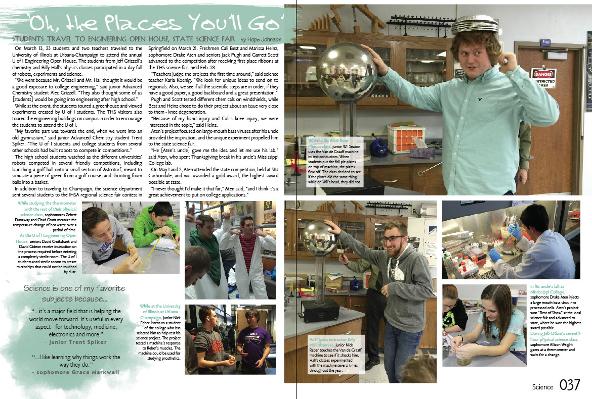
'Oh, the Places You'll Go'
Students travel to Engineering open house, state science fair
On March 13, 23 students and two teachers traveled to the University of Illinois at Urbana-Champaign to attend the annual U of I Engineering Open House. The students from Jeff Grizzell’s chemistry and Billy Hall’s physics classes participated in a day full of robots, experiments and science.
“We went because Mr. Grizzell and Mr. Hall thought it would be a good exposure to college engineering,” said junior Advanced Chemistry student Alec Grizzell. “They also thought some of us [students] would be going into engineering after high school.”
While at the event, the students toured a greenhouse and viewed experiments created by U of I students. The THS visitors also toured the engineering buildings on campus in order to encourage the students to attend the U of I.
“My favorite part was towards the end, when we went into an old gymnasium,” said junior Advanced Chemistry student Trent Spiker. “The U of I students and college students from several other schools had built robots to compete in competitions.”
The high school students watched as the different universities’ robots competed in several friendly competitions, including launching a golf ball onto a small section of Astroturf, meant to simulate a piece of green from a golf course, and shooting foam balls into a basket.
In addition to traveling to Champaign, the science department sent several students to the IHSA regional science fair contest in Springfield on March 21. Freshmen Cali Best and Marissa Heinz, sophomore Drake Aten and seniors Jack Pugh and Garrett Scott advanced to the competition after receiving first place ribbons at the THS science fair, held Feb. 28.
“Teachers judge the projects the first time around,” said science teacher Karla Koenig. “We look for unique ideas to send on to regionals. Also, we see if all the scientific steps are in order, if they have a good paper, a good backboard and a great presentation.”
Pugh and Scott tested different chemicals on windshields, while Best and Heinz chose to do their project about an issue very close to them - knee degeneration.
“Because of my hand injury and Cali’s knee injury, we were interested in the topic,” said Heinz.
Aten’s project focused on large-mouth bass viruses after his uncle provided the inspiration, and the unique experiment propelled him to the state science fair.
“He [Aten’s uncle] gave me the idea and let me use his lab,” said Aten, who spent Thanksgiving break in his uncle’s Mississippi College lab.
On May 1 and 2, Aten attended the state competition, held at SIU Carbondale, and was awarded a gold award, the highest award possible at state.
“I never thought I’d make it that far,” Aten said, “and I think it’s a great achievement to put on college applications.”
